Janasco-area mesa
Cry MachoThe Janasco-area mesa is a landscape of open tablelands where Mike and Rafo look for wild horses, and where the search repeatedly tests the difference between imagining the wilderness and meeting its limits. Its immense, quiet spaces offer a striking contrast to the organized spectacle of Mike’s rodeo career; the horses themselves are neither dependable scenery nor a guaranteed means of escape, but elusive animals whose presence changes the course of the search.
Setting and Landscape
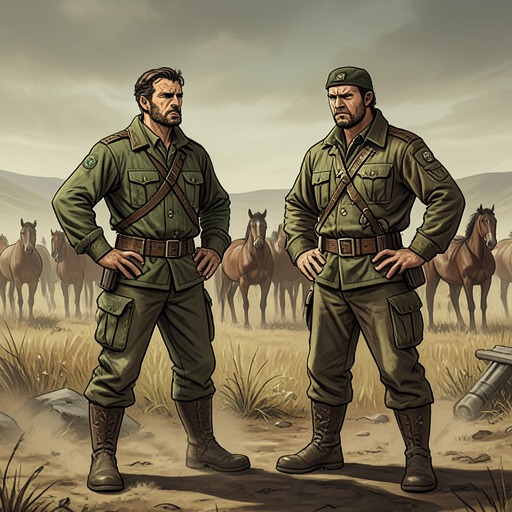
Mike reasons that wild horses prefer tablelands to woods and hills: open ground offers fewer obstructions, while a fall could be fatal. The terrain around Janasco gives the pair several mesas to choose from, one rising beyond another. Their abundance makes selection seem arbitrary, though Mike finds nearly all the tablelands beautiful.
The third mesa they explore that afternoon leaves a particular impression. It appears vast and spare, with space, sun, and stillness dominating the view. A closer look reveals sage, cactus, catchweed, and goosegrass, but little that interrupts the openness. Even Mike’s truck seems strangely out of place in the landscape, its silhouette against the sunset lending it an unreal quality. Rafo, standing apart and wanting solitude, seems to Mike not to disturb the surroundings when he is still.
That quiet is not simply restful. Mike feels lonely and happy at once, and the prospect of spending the night outdoors eventually makes the open plateau seem less welcoming: darkness and cold could turn its beauty into exposure. The mesa’s appeal therefore carries a practical edge. It is a place that invites attention and offers room to move, but it does not provide food, fuel, shelter, or safety by itself.
Evidence of the Horses
The first search yields no living mustangs. Instead, Mike and Rafo find scattered remains, including a group of roughly fifty or sixty across part of the plateau. Mike imagines that two horses may have fought over a mare or territory, while the larger group may have died from disease or drought. These are possibilities rather than explanations: the cause of the deaths remains uncertain, and Mike concludes that the horses he had hoped to find may no longer be present.
That conclusion quickly alters the afternoon’s mood. Mike is hot and discouraged, and the mesa that had seemed promising now appears to offer no horses at all. The change matters because the search is not merely scenic. Mike hopes to catch horses and make enough money to continue north; without them, the landscape’s beauty cannot resolve the pair’s immediate lack of supplies or their wider difficulty of getting away.
Later, the mesa overturns his certainty. At night, Mike hears neighing and runs outside, with Rafo following. They see three mustangs on the horizon, then a larger herd racing across its broad arc. The animals appear and disappear against successive stretches of sky, and the sound reaches the pair from a distance. Their sudden appearance makes the earlier absence feel provisional: the horses are present, but not where or when the searchers can command them.
Capture and Changing Prospects
Mike and Rafo do manage to capture one horse. The next effort, however, is harder. It is as if the herd has learned from that capture and left the mesa. Through the rest of the day and again at night, Mike sees no sign of mustangs; even as he watches the empty horizon while Rafo sleeps, the tableland offers only stillness.
On their third day in Janasco, the pair spot four horses grouped closely together. Rafo cannot bring the truck near enough, and the animals scatter in different directions before they can be approached. The failed attempt turns observation into a practical lesson: Mike decides that next time they should use a rope. The mesa supplies opportunities, but each one depends on distance, timing, and the horses’ response, not simply on the men’s determination.
The capture attempt itself brings that struggle into immediate focus. With the truck close alongside a white mustang, Mike stands ready and jumps onto the animal. It continues moving as though his weight has not checked it, then rises in an effort to throw off the burden. Mike holds on. The scene makes the open tableland an arena of another kind, but unlike a rodeo performance its outcome is not secured by a set schedule or a paying audience.
Narrative Significance
For Mike, the mesa’s wild horses stand apart from the animals and riders he has encountered in commercial rodeos. At Polk’s Cow Stadium, a banner and a large photograph turn his riding into a public image, while the show presents him as a celebrated performer. In the arena, Howard Polk’s management recasts the cowboys as actors. On the mesa, by contrast, horses are not part of a scheduled event: they appear at a distance, vanish, or evade approach, and the men must adapt to their movement.
This contrast deepens the tension in Mike’s idea of toughness. He has spent much of his life in arenas where courage and mastery are displayed before spectators, yet he is also troubled by the human power to decide how animals should be treated. His earlier animal-inspection work had made him question the arbitrary line between animals considered curable and those written off. The mesa does not settle that question, but it places the horses beyond the orderly spectacle that had shaped his public identity. Their scarcity, their remains, and their ability to escape the truck’s approach give the landscape a consequence beyond its beauty: it limits what the men can assume, control, or take from it.